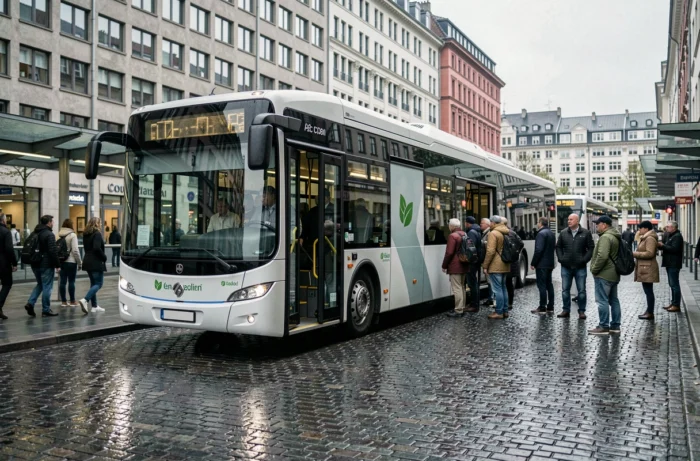
The transport sector in France experienced a year of contrasts in 2024. On one hand, record attendance on the rail network. On the other hand, European road transport remains under pressure, with squeezed margins and tightening regulations. Understanding these dynamics allows for anticipating what will change for both professionals and travelers.
New CO2 Standards for Heavy Goods Vehicles: What the 2024 European Regulation Changes
The regulation (EU) 2024/1610 of May 14, 2024, imposes a trajectory for reducing CO2 emissions for new heavy goods vehicles, calculated from a reference set in 2019. Heavy goods vehicles are now subject to the same decarbonization logic as light vehicles.
Manufacturers must sell increasingly low-emission trucks, or face financial penalties. For road transport companies, the consequence is direct: fleet renewal costs more, as alternative powertrains (electric, hydrogen, biogas) remain more expensive to purchase than a conventional diesel.
This regulation also accelerates the deployment of charging infrastructure, as part of the AFIR regulation that came into effect in spring 2024. Transporters who anticipate this transition have a competitive advantage. Those who wait risk facing rising costs without having prepared their fleet.
To keep track of developments in these areas, transport news on Actualités Voyages allows you to keep an eye on the major trends in the sector, from freight to passenger mobility.
Total Transport Expenditure in France: A 2024 Report on the Rise

Total transport expenditure in France reached €536.8 billion in 2024, an increase of 2.5% in value compared to 2023. This amount exceeds the pre-health crisis level by more than 20%. Transport has not only regained its pace: it has surpassed it.
Why this increase? It mainly comes from public transport, whose expenditures surged by 8.4%, in a context where prices for these services remained stable. Households have therefore traveled more by train, bus, and metro, without experiencing inflation on tickets.
Individual transport expenditures (car, motorcycle) have progressed much more slowly, at only 0.4%. Individual transport still accounts for about 80% of household travel expenses excluding insurance, but its relative weight is decreasing in favor of public transport.
Infrastructure Investments
Investment expenditures in transport infrastructure increased by 3.9% to reach €27.3 billion. This increase concerns three main areas:
- The road network, which absorbs the largest share despite the priority given to rail
- The main rail network, with regeneration and modernization projects for existing lines
- Urban public transport, driven by tramway, high-service bus, and metro extension projects in Île-de-France
Tax revenues related to transport reached €66 billion, an increase of 5.4%. The state and local authorities are thus capturing an increasing share of the wealth generated by the sector.
European Road Transport: A Still Fragile Demand in 2024
The French macro report masks a harsher reality for road freight on a European scale. Road transport demand remained weak in Europe, with prices under pressure and margins continuing to shrink for transporters.
Costs, on the other hand, have not decreased. Fuel, wages, tolls, regulatory compliance: each item weighs more heavily. For a road freight transport company, profitability erodes mechanically when rates stagnate and costs increase.
This imbalance particularly affects smaller structures. Large fleets can negotiate volumes and optimize their routes using advanced logistics tools. Independent transporters do not have this flexibility.
The Impact on the French Market
In France, road freight transport remains the dominant mode for domestic flows. Competition with rail and waterways exists on paper, but in reality, trucks handle the majority of French land freight.
Regulatory pressure (CO2 standards, social rules, enhanced technical inspections) is pushing the sector towards consolidation. Acquisitions of transport companies are multiplying, and the players who survive are those who invest in training, digitalization, and the energy transition of their fleet.
Rail and Urban Mobility: Positive Signals from 2024
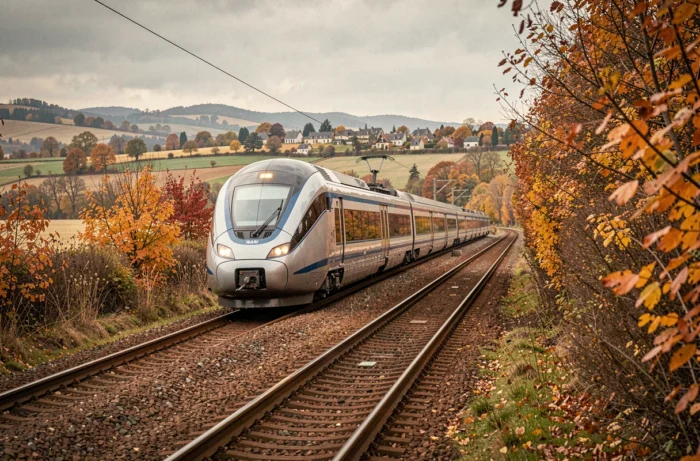
Rail transport recorded a new attendance record in 2024. All services (TGV, TER, Intercités, Transilien) saw their offerings and attendance increase, according to the Transport Regulatory Authority.
- The supply of trains has significantly increased, with more services on the most requested lines
- Service quality has markedly improved after six consecutive years of degradation
- Average price changes have remained moderate compared to overall inflation
Sectors open to competition show better control over prices and costs. The gradual arrival of alternative operators on certain regional lines is beginning to produce measurable effects on quality and pricing.
In Île-de-France, public transport usage accelerated in 2024, notably driven by the Paris Olympic and Paralympic Games. The event generated an influx of travelers on the Île-de-France network, but also highlighted the capacity limits of certain lines.
Air transport in Île-de-France continued its recovery without returning to pre-health crisis levels. Domestic flights are declining in favor of trains on routes where the TGV offers comparable travel times.
The year 2024 thus confirmed a gradual shift in usage towards rail and urban public transport. This movement does not erase the dominance of road transport, nor the structural difficulties of freight. But it outlines a landscape where each mode must justify its relevance through pricing, reliability, and carbon footprint.