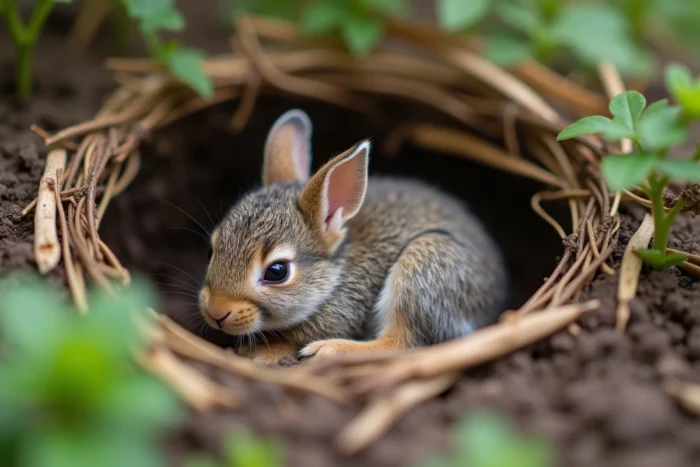
A baby rabbit found alone in a garden or field almost never means abandonment. The mother rabbit nurses her young one to two times a day, usually at dawn and dusk, and then deliberately moves away from the nest to avoid attracting predators. Before taking any action, we recommend assessing the situation according to specific criteria rather than succumbing to the instinct to pick it up.
Warming the baby rabbit before feeding
A baby rabbit in hypothermia should never be fed. This is the most underestimated guideline in popular articles, yet feeding an animal in hypothermia significantly increases the risk of death. The digestive system of a chilled mammal cannot properly assimilate milk or solutions, leading to fatal gastric fermentations.
The SPAE of Évreux explicitly reminds us: do not feed a found baby, warm it up first. Hydration or feeding should only occur after validation by a care center or veterinarian.
To warm a baby rabbit, we use a warm water bottle (water at body temperature, around the warmth of a hand) wrapped in a cloth, placed under or next to the animal in a closed box with holes. Direct contact with a heat source burns the delicate skin of newborns. Gradual warming over 30 to 60 minutes before any other handling.
This protocol applies to both wild baby rabbits and domestic rabbits found outside of a breeding facility. You can find practical advice from X Anima detailing the care of an apparently abandoned newborn rabbit.
Handling the baby rabbit: gloves and sanitary precautions
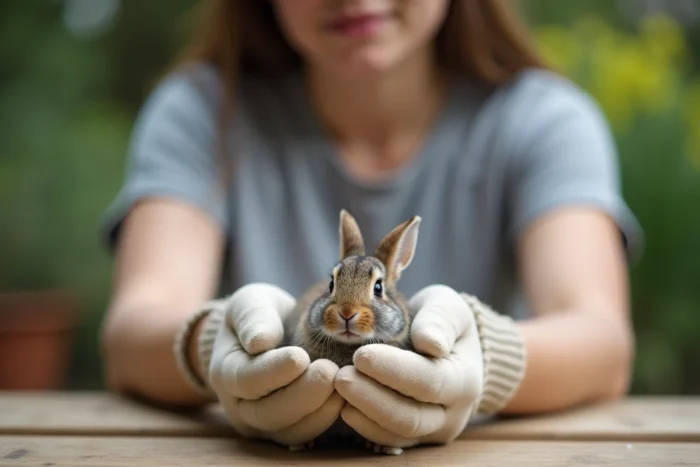
Wildlife centers recommend never handling a young mammal with bare hands. This guideline goes beyond the simple issue of human scent (often overestimated: the mother rabbit does not systematically reject a baby touched by humans). It addresses two concrete issues.
- The risk of exposure to zoonoses, including rabies in areas where the virus still circulates among terrestrial mammals. Gardening gloves, latex, or leather are sufficient to limit direct contact in case of a reflex bite.
- Health traceability: in case of a bite or scratch, wearing gloves simplifies the risk assessment by veterinary authorities and avoids a precautionary rabies protocol.
- Thermoregulation: bare hands absorb the residual heat from the baby rabbit, worsening hypothermia. A cloth or glove better maintains the animal’s temperature during transfer.
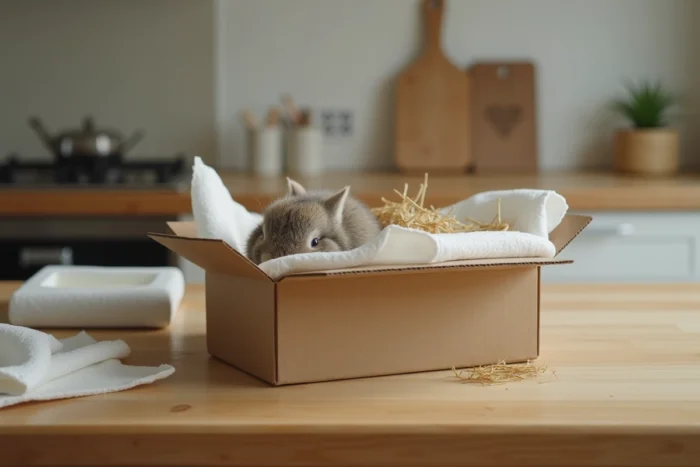
Place the baby rabbit in an opaque container (cardboard, shoebox), lined with absorbent paper or non-linting fabric. Avoid cotton, as its fibers can wrap around the legs and cause constriction.
Distinguishing between wild baby rabbits and domestic rabbits
The confusion between the two entirely determines the course of action. A wild rabbit is a protected species whose possession is prohibited under Article L411-1 of the Environmental Code. The only legal exception allows transport to the nearest wildlife rescue center.
The wild baby rabbit can be recognized by its uniform brown-gray fur from birth, its proportionally long hind legs, and its fleeing behavior from the first days of mobility. The domestic rabbit (including dwarf rabbits) has varied coats, shorter or drooping ears depending on the breed, and a less fearful demeanor.
If in doubt, we recommend contacting a wildlife care center directly rather than a general veterinarian. Canine or feline practitioners may not always have the specific training for wild lagomorphs, and prolonged possession of a wild rabbit without authorization exposes one to penalties.
When to leave the baby rabbit in place and when to intervene
The majority of baby rabbits found alone do not require any intervention. Every spring, we observe dozens of unnecessary reports related to a lack of understanding of maternal behavior. Here are the decision criteria.
- The baby rabbit is warm, round, the skin is supple and not wrinkled, it is not vocalizing: it is being fed. Replace it in the nest if you have moved it and leave the area.
- The baby rabbit is cold, thin (skin wrinkled on the sides, hollow belly), dehydrated (persistent skin fold when gently pinching the nape): it has likely missed several feedings. Warm it up and contact a care center.
- Visible injuries, flies or maggots on the body, traces of blood: veterinary emergency. Transfer to a rescue center is the only legal option for a wild rabbit.
- The nest has been destroyed (plowing, mowing, construction): gather the baby rabbits in a container lined with the original nesting material (fur, dry grasses), place it in the same location, and move away. The mother rabbit often returns in the following hours.
To check for the mother’s return, place two strands of thread or yarn in a cross above the nest. If the device is moved after one night, the mother rabbit has passed.
Contacting a wildlife center: the right reflex
A rescue center has the equipment, milk formulated for lagomorphs, and most importantly, the legal authorization to keep a wild animal. Keeping a wild baby rabbit at home is prohibited, even temporarily beyond transport to the center.
Some centers may announce that they are at capacity, especially during peak spring periods. In this case, ask for a referral to another facility or to an authorized referring veterinarian. Do not release a weakened baby rabbit into the wild without professional advice: an animal in hypothermia or dehydration will not survive without care.
The most protective reflex for a found baby rabbit often remains the most difficult to apply: do nothing, observe from a distance, and only intervene based on objective signs of distress. Most baby rabbits recovered by well-meaning individuals would have survived without intervention.