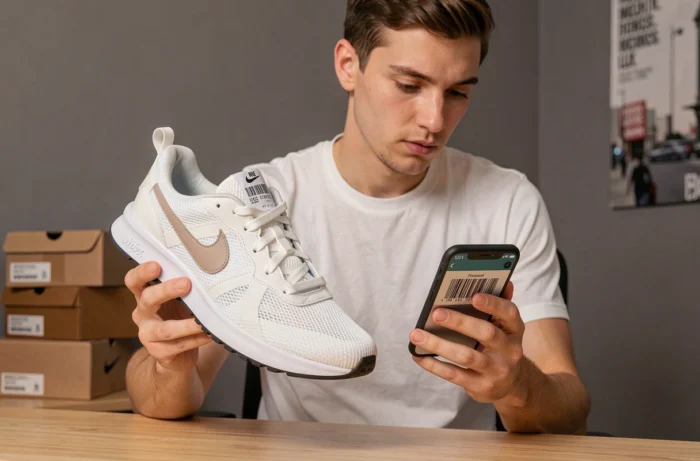
You have just received a pair of Nike shoes purchased online. The box seems fine, the Swoosh looks well placed, and the stitching appears solid. But a doubt lingers. The most common reflex is to scan the barcode on the box to verify the Nike UPC code. This is a good starting point, provided you understand what this code actually proves, and especially what it does not prove.
Why the Nike UPC code is not sufficient on its own
The UPC (Universal Product Code) is a series of numbers associated with a barcode, printed on the box of each pair of Nike shoes. By scanning it with an app like Barcode Lookup or Barcodes.GG, you get the product name, its color, and sometimes its suggested retail price.
The problem is simple: a UPC can be copied onto a counterfeit box. A counterfeiter only needs to take the code from an authentic pair and print it on their packaging. The scan will then return a completely coherent result, even if the pair inside is not real.
Several specialized sources actually rank the anti-counterfeiting reliability of the UPC code as “low” when used alone. Before relying solely on this scan, you need to know how to verify the original Nike UPC code by cross-referencing it with other elements present on the shoe itself.
Cross-checking UPC and Nike inner label
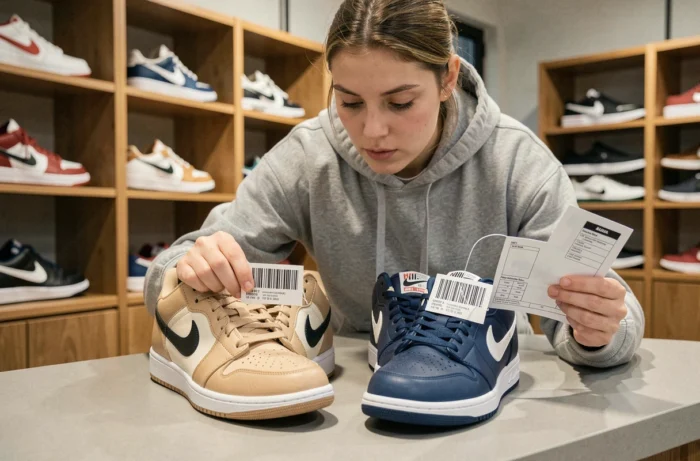
The most reliable method is not to scan, but to match. Here’s the principle: the UPC code on the box must exactly correspond to the model, color, and size of the pair you have in hand. If the scan result shows a different colorway or another model name, it’s an immediate red flag.
Always systematically compare three elements between the box and the inner label of the shoe (stuck under the tongue or on the inner side):
- The style code (also called SKU code), made up of numbers and letters, must be identical on the box and on the shoe label. A discrepancy, even by a single character, indicates a problem.
- The size indicated on the inner label must match the one printed on the box, across all conversions (US, UK, EUR, CM).
- The country of manufacture mentioned on the label must be consistent with the model. Nike produces in several countries, but each production line is associated with identified factories.
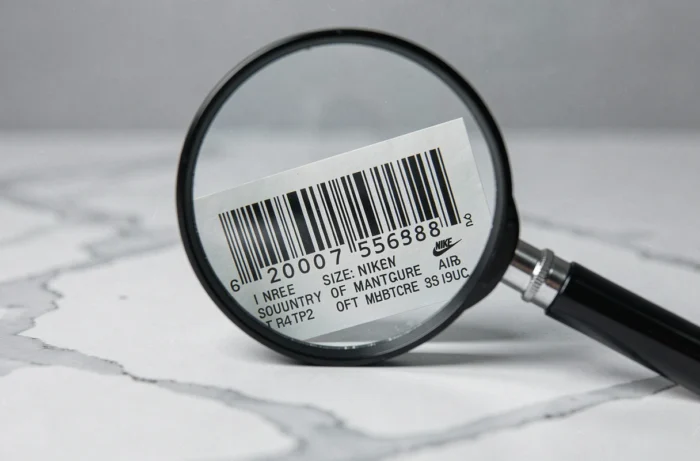
You may have noticed that some inner labels appear blurry or slightly misaligned? On an authentic pair, the font of the label is sharp and the numbers are perfectly aligned. Recent counterfeits are getting better at mimicking this aspect, but irregular spacing between characters remains a frequent indicator.
Scanning the Nike barcode: the correct step-by-step method
Taking your phone and scanning the barcode takes just a few seconds. What matters is what you do with the result.
Open a barcode reading app (Barcode Lookup, Barcodes.GG, or the camera on your smartphone on certain models). Scan the UPC code located on the label of the box. The app will then display a product sheet.
The result must exactly match the model you have in hand. Check the full product name, the colorway, and the reference. If the scan returns no result, it doesn’t necessarily mean the pair is fake: some very recent or regional editions take time to appear in public databases.
On the other hand, if the result shows a completely different model from the one you have, caution is warranted. Cross-check with the style code listed on the inner label of the shoe.
Official Nike tools and third-party authentication apps
Nike is increasingly directing its buyers to its own verification tools. The Nike help site offers a support pathway to report a suspicious product, and some recent models include a QR code or NFC chip directly in the shoe.
These technologies are harder to reproduce than a simple barcode printed on cardboard. A Nike QR code integrated into the label links to an official page that confirms the model and its features. If the QR code doesn’t work or redirects to an unknown site, it’s a clear signal.
As for third-party apps, services like CheckCheck or Legit Check offer photo authentication. You send pictures of the pair from multiple angles, and experts (human or AI-assisted) provide a verdict. These services are paid, but they add a layer of verification that a simple UPC scan cannot offer.
- The UPC scan verifies that the code corresponds to a referenced Nike product, without guaranteeing that the physical pair is authentic.
- The Nike QR code or NFC chip, when they exist, provide a more direct verification because they are integrated into the product itself.
- Photo authentication apps analyze physical details (stitching, materials, fonts) that the barcode cannot assess.
Common mistakes that skew UPC code authentication
The first mistake is relying solely on the box. An authentic box can be reused to package a counterfeit. The UPC will then be perfectly valid when scanned, but the pair inside will have nothing to do with it.
The second mistake is neglecting the size match. If the size on the box does not match that of the inner label, the pair is suspicious, even if the barcode returns a correct result.
The third trap: assuming that a code not found in databases automatically means a counterfeit. Public databases are not exhaustive, and some products distributed in specific geographical areas simply do not appear there.
The UPC code remains a quick sorting tool, not a certificate of authenticity. Combined with the physical inspection of the inner label, the style code, and the official Nike tools, it forms a piece of a larger puzzle. None of these checks taken in isolation guarantee the authenticity of a pair. It is their convergence that allows for a decisive conclusion.