
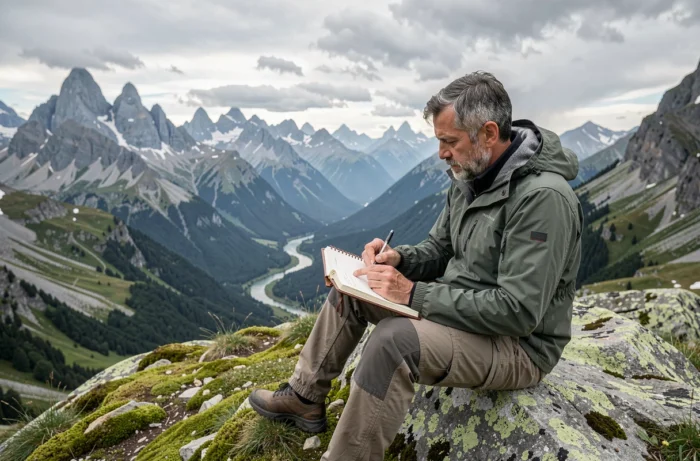
A travel diary in photos documents an itinerary through organized, annotated, and narrated images. Unlike a simple souvenir album, it structures the snapshots around a narrative thread: encounters, places, surprises. This approach transforms a series of digital files into a readable, shareable, and lasting object.
Photo travel diary: from raw file to art book
Photo editing platforms like Photobox or PosterXXL have evolved their recent collections towards a logic of personal storytelling. The principle: abandon strict chronological order to adopt thematic chapters (encounters, favorite places, surprises).
This format borrows from the codes of magazines and beautiful books. It integrates digitized handwritten texts, itinerary maps, scanned tickets. The result resembles more of an art book than a family album.
For globetrotters who accumulate hundreds of photos per destination, this thematic structure solves a concrete problem: it forces sorting, prioritizing, and keeping only the images that serve the narrative. Documenting a trip on voyager-en-images.fr follows this same logic of selection and visual storytelling.
A common pitfall is wanting to keep everything. An effective travel diary relies as much on elimination as on selection. Three strong photos of a market tell more than a series of twenty shots taken from the same angle.
Drone regulations and travel photography in Europe
Many travel diaries now include aerial shots. The European regulatory framework has evolved significantly in recent years, and ignoring it can be costly.
The EASA regulation (EU 2019/947) structures flights into three categories: Open, Specific, and Certified. For travel photography, the Open category covers most uses, but it imposes specific constraints.
What the EASA regulation changes for traveling photographers
- Mandatory registration as an operator as soon as a drone carries a camera, even a lightweight device intended for landscape photography
- Remote ID is becoming widespread and is a technical prerequisite for recent devices
- Each country retains specific exclusion zones (national parks, heritage sites, military areas) that add to the common European framework
A globetrotter planning to fly over the Canary Islands, the Netherlands, or Scandinavia must check local rules in addition to the EASA framework. Compliance is not uniform from one country to another, even within the European Union.
Specifically, before each destination, one must consult the airspace maps of the concerned country and check if a prefectural or equivalent authorization is required. Photographing an Icelandic volcano or a Croatian coast from a drone without this verification exposes one to fines and confiscation of equipment.
Building a photo itinerary: method through visual scouting
Planning a trip around photography is not done like a classic tourist circuit. The photo itinerary is built backward, starting from the desired images, not from the monuments listed in a guide.
The method consists of first identifying the light conditions and seasons. The same location produces radically different images depending on the time and month. Experienced globetrotters scout their spots using solar mapping tools that indicate the sun’s angle on a given date.
Three criteria for selecting a photo stop
- The visual diversity of the location: a site that offers several types of framing (panorama, detail, portrait) justifies a prolonged stop
- Accessibility during golden hours (sunrise and sunset), which sometimes requires staying overnight rather than in a nearby city
- The presence of strong narrative elements: markets, artisans, scenes of daily life that anchor the diary in reality
This approach changes the logic of travel. Instead of increasing the number of countries or cities, a successful travel diary relies on fewer stops and more time per location. Spending three days in a fishing village produces a more coherent photographic narrative than flying over five capitals in ten days.

Archiving and longevity of photographic memories
The question that few travelers ask before departure is about the lifespan of their photos. A hard drive can fail, a cloud account can be deleted, a memory card can corrupt. Archiving is the weak link of the digital travel diary.
The basic rule in photographic archiving is redundancy: each image exists on at least two physically separate media. While traveling, this means transferring files each evening to a second medium (portable drive, cloud storage via local network).
The printed photo diary, beyond its aesthetic appeal, also serves an archiving function. A well-bound book can last for decades without software updates or format migration. Recent editions offer paper with a sufficiently dense weight to withstand repeated handling.
For digital files, the RAW format remains preferable to compressed JPEG if further processing is anticipated. A travel diary whose source images are in high resolution can be reissued, cropped, or reprinted years after returning.
The photographic travel diary benefits from being thought out from the preparation of the trip, not upon return in front of a folder of scattered files. Choosing chapters, scouting lights, securing files: these technical gestures transform a collection of memories into an object that can be passed down.