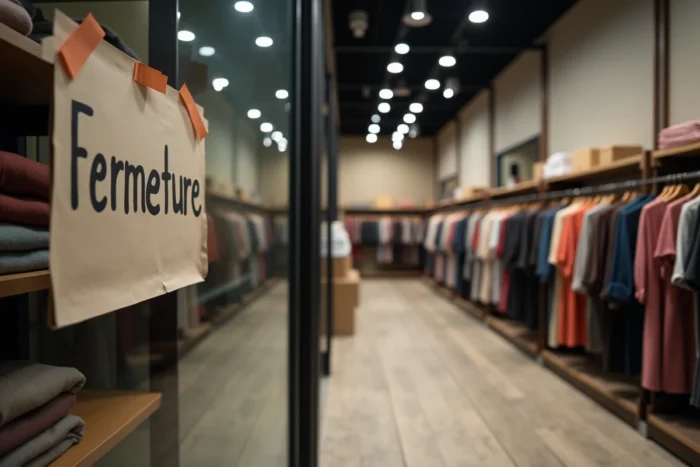
Christine Laure, a women’s ready-to-wear brand founded in Gray in 1961, underwent a judicial recovery procedure opened in August 2024 at the commercial court of Dijon. The takeover by Amoniss, a holding company owned by Salih Halassi, who is already the owner of Pimkie and Chevignon, was validated at the end of 2025. It remains to be seen what this acquisition concretely changes for the network, the collections, and the brand’s positioning.
Acquisition by Amoniss: the real scope of the Christine Laure takeover
The offer selected by the commercial court of Dijon stands out from the other two candidates (the Antonelle-Un Jour Ailleurs-Kookaï group and the Lyon-based manufacturer Avona) by one structuring point: Amoniss retains almost all of the retail outlets. This choice to maintain the physical network is significant in a sector where acquisitions often come with a massive dismantling of the store network.
The social aspect remains heavy. Out of 284 positions that Christine Laure had, 84 jobs are not being retained, which is nearly a third of the workforce. The cuts mainly affect support functions and certain stores deemed unviable. In Gray, where the historical headquarters and logistics base are located, the activity is maintained, preserving the company’s territorial anchoring in Bourgogne-Franche-Comté.
A detailed analysis of the future of Christine Laure on Marina Mode reviews the steps of this procedure and the conditions of the acquisition.
Amoniss Strategy: what Pimkie and Chevignon reveal about the plan for Christine Laure
Amoniss is not new to acquiring struggling brands. The holding company bought Pimkie two years before Christine Laure, and then Chevignon in September 2025. This acquisition pace outlines a multi-brand portfolio strategy targeting well-known French brands that are losing commercial momentum.

We observe a recurring pattern in these acquisitions: maintaining the trade name, reducing fixed costs (closing unprofitable stores, renegotiating leases), and gradually repositioning the offering. For Christine Laure, whose target clientele remains women over 50, the question of repositioning is more delicate than for Pimkie, which targets a young and digital audience.
The grouping under one portfolio of brands with such different targets raises an operational question: will the logistical and purchasing synergies be sufficient to compensate for the low commercial complementarity between Pimkie, Chevignon, and Christine Laure? Amoniss will need to prove that its logic of mutualization also works with a brand whose model relies on physical proximity and in-store advice.
Christine Laure Store Network: which stores are closing, which ones survive
Before the judicial recovery, Christine Laure operated 145 stores in France, including 51 affiliates, complemented by a network of over 200 multi-brand stores. The retention of almost the entire network by Amoniss does not mean that all retail outlets will remain open indefinitely. Several criteria determine a store’s survival in this type of restructuring:
- The profitability of the commercial lease: high-rent, low-traffic locations in city centers are the first targeted for closures, especially when the lease is set to expire in the months following the acquisition.
- The local customer base: stores located in areas with a high proportion of senior customers retain an advantage, while locations in fast-fashion-oriented shopping centers lose relevance.
- The presence of affiliates: affiliated stores, managed by independents, represent a lower financial risk for the acquirer. Their retention depends on each affiliate’s willingness to continue under the new management.
The territorial network remains the main asset of Christine Laure. In the senior ready-to-wear sector, online sales do not compensate for the absence of a physical store. The brand’s historical clientele prefers trying on clothes, interacting with a sales associate, and regular visits to the store. Losing too many retail outlets would undermine the only competitive advantage the brand retains against e-commerce giants.
Collections and pricing strategy: what needs to change for Christine Laure
The judicial recovery of Christine Laure cannot be explained solely by the state of the French ready-to-wear market. The product offering had not evolved sufficiently to meet the expectations of an increasingly targeted senior clientele by brands like Damart, Blancheporte, or dedicated ranges from major generalist brands.
The strategic plan launched in February 2024, even before the judicial recovery, already aimed to reposition the collections. We recommend monitoring three areas to assess the credibility of the Amoniss project:
- Style renewal: Christine Laure must modernize its cuts and materials without betraying the comfort and quality expectations of its clientele. A too abrupt shift towards younger codes would alienate the existing customer base without attracting a new segment.
- Pricing policy: in a market where senior customers now compare prices online, the quality-price ratio must justify the trip to the store. The margins of the physical network do not allow alignment with pure e-commerce prices.
- Digital communication: Christine Laure was significantly lagging behind on digital channels. Without investment in online sales and social networks suited to the target audience (Facebook remains the dominant channel among those over 50), the brand will remain invisible to a growing part of its clientele.
Senior ready-to-wear in France: a segment under pressure but not doomed
The case of Christine Laure is part of a series of difficulties affecting the French ready-to-wear market for several years. Brands targeting women over 50 face a double constraint: declining foot traffic in city centers and increased competition from e-commerce. The senior segment remains profitable as long as distribution costs are managed.
The acquisition by Amoniss represents a real-world test. If the holding company can stabilize the Christine Laure network while modernizing the offering, it will demonstrate that a model of physical stores can still work in this segment. The alternative, a shift to an all-online model, seems poorly compatible with the purchasing habits of the target clientele.
The coming months will be crucial to gauge the actual number of stores retained after the restructuring phase and to verify whether the collections offered under Amoniss’s direction meet the expectations of a loyal but demanding clientele.