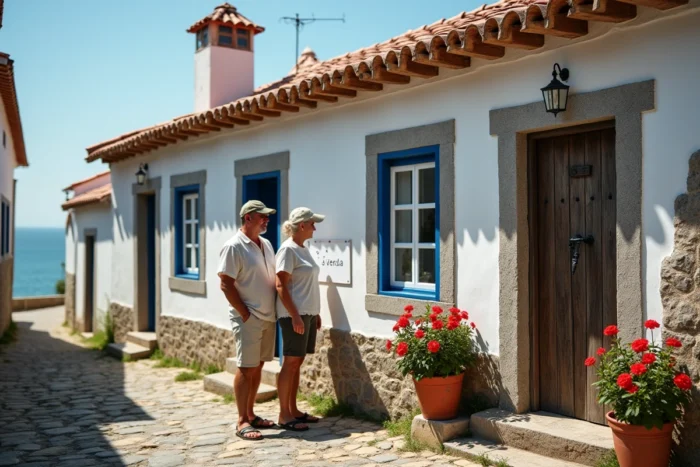
The rental yield of real estate in Portugal is around 7.3% according to the latest available data, but this average figure masks very different realities depending on the type of property. In the segment of small fishermen’s houses, profitability depends less on the overall market than on regulatory and urban planning constraints that most buyers discover too late.
Licença de habitação and legal compliance: the real filter before any investment in Portugal
A fishermen’s house without a licença de habitação cannot be legally resold or rented out. This document, equivalent to the French certificate of conformity, certifies that the property meets current habitability standards. Its absence turns a real estate asset into a dead-end investment.
We observe that many old coastal buildings have never undergone a regularization procedure. They were built or modified at times when urban planning control was minimal. The buyer who signs without checking this point ends up with a property that they cannot exploit without undertaking sometimes significant compliance works.
Before committing to a small fishermen’s house for sale in Portugal, we recommend systematically requesting the caderneta predial (land registry document) and the up-to-date licença de habitação. If the seller cannot produce the latter, the cost of regularization should be estimated before negotiating the purchase price.

PARL 2040 Program: coastal constraints and impact on the value of fishermen’s houses
The Action Program for Coastal Resilience 2040 (PARL 2040) is a factor that almost no article aimed at French buyers mentions. This program governs the planning and protection of the Portuguese coastline, with direct consequences for properties located on the front line of the coast.
Specifically, a property identified within the scope of PARL 2040 may face renovation restrictions, prohibitions on extensions, or obligations to set back from the coastline. In the most constraining cases, the future liquidity of the property is compromised: a potential buyer will hesitate to take on an asset whose use is limited by regulation.
Checking whether the parcel falls within an area affected by PARL 2040 is a minimum due diligence requirement. The consultation can be done with the câmara municipal (municipality) or through the cartographic tools of the Agência Portuguesa do Ambiente. A coastal property not affected by PARL 2040 is structurally worth more than an equivalent property located in a risk zone.
Searching for listings in Portugal: local vocabulary and manual filtering
Portuguese real estate portals do not categorize properties under the label “fishermen’s house.” Searching solely for this expression in French or English excludes the majority of the actual offerings.
The terms to use on local platforms are specific:
- “Moradia térrea” refers to a single-story house, the typical format of old fishermen’s homes along the coast
- “Casa rústica” corresponds to rural or traditional properties, often classified as such even in coastal areas
- “Casa para recuperar” specifically targets properties to be renovated, a category into which most authentic fishermen’s houses fall
Filtering remains manual. One must cross-reference the location with proximity to the sea, check the urban zoning, and eliminate properties located in agricultural zones (where changing the use is difficult). This method takes time, but it provides access to a stock of listings that is invisible to those limited to French-speaking portals.
Actual prices and trade-off between the Algarve and secondary markets
The image of Portugal where one buys a house by the sea for a modest sum no longer corresponds to reality in the tourist Algarve. In the most sought-after areas, very degraded old buildings are already negotiating at high levels, and the supply below attractive thresholds has nearly disappeared.
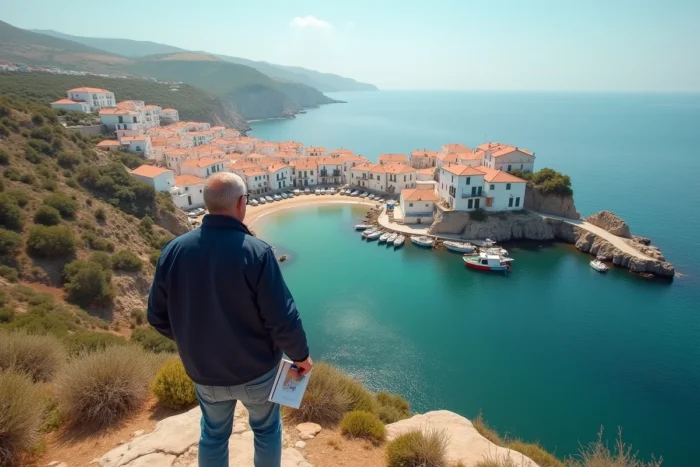
This observation shifts interest towards secondary markets. The Alentejo coast (between Comporta and Zambujeira do Mar), the Silver Coast north of Lisbon, or certain villages on the Vicentine coast still offer accessible entry points. Secondary markets currently concentrate the best potential for capital appreciation precisely because they have not yet been saturated by international demand.
We recommend comparing based on three objective criteria before choosing a region:
- The price per square meter of properties to be renovated within a five-kilometer radius of the targeted property
- The dynamics of seasonal rental demand, verifiable through occupancy rates on short-term rental platforms
- The level of local regulatory constraint (PARL 2040, Natura 2000 area, municipal master plan)
Renovation and rental yield: how the renovation budget changes things
Buying a fishermen’s house to renovate in Portugal does not guarantee a rental yield higher than that of a ready-to-live-in property. The calculation depends on the ratio between the total cost (acquisition plus renovation) and realistic rental income.
Compliance works (roofing, electrical network, sanitation) often represent a burden as heavy as the purchase price itself for the most degraded properties. On the other hand, a careful renovation in a little-known coastal village can generate a very high seasonal occupancy rate, because the supply of renovated housing remains low against a growing demand.
The Portuguese real estate market is becoming less risky but also yields less than it did a few years ago. The selection of the property, legal verification, and calibration of the renovation budget make all the difference between a profitable investment and a frozen asset. In this segment of fishermen’s houses, thoroughness in advance favorably replaces intuition.