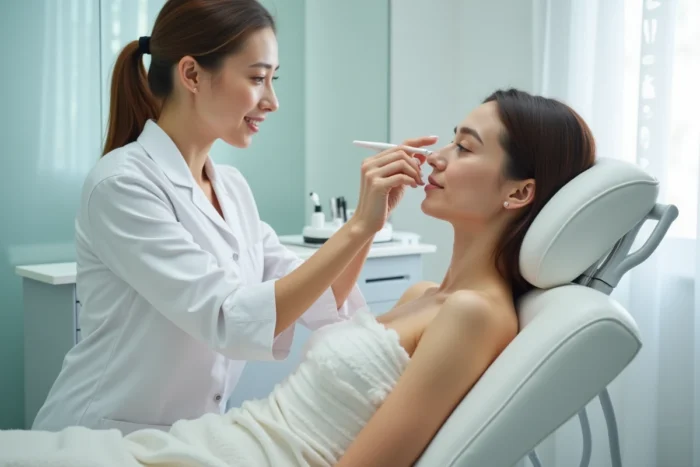
Facial aesthetics encompasses all treatments aimed at maintaining, correcting, or enhancing the appearance of the skin and facial structures. Some fall under cosmetics (skin cleansing, superficial peeling, moisturizing treatment), while others are part of aesthetic medicine (injections, laser, invasive procedures). The boundary between these two categories is regulated, and confusing them can lead to complications that are sometimes irreversible.
Concrete risks of a facial treatment performed without qualification
ANSES has reported an increase in adverse effects related to at-home facial peels, particularly chemical burns and post-inflammatory hyperpigmentation. The main cause: the use of overly concentrated acids without professional oversight.
The problem extends beyond peels. Online communities encourage “DIY” injections of botulinum toxin or filler products. Documented complications include facial asymmetries, infections, and in the most severe cases, vascular occlusions that can cause necrosis or vision loss when the arteries in the ocular region are affected.
These situations are not mere anecdotes. They reflect a normalization of technical gestures that require precise knowledge of facial anatomy, particularly the peri-orbital and nasolabial vascular networks. A qualified practitioner knows how to locate these at-risk areas before any intervention, as advised by Santé Radieuse regarding the choice of a specialized physician.
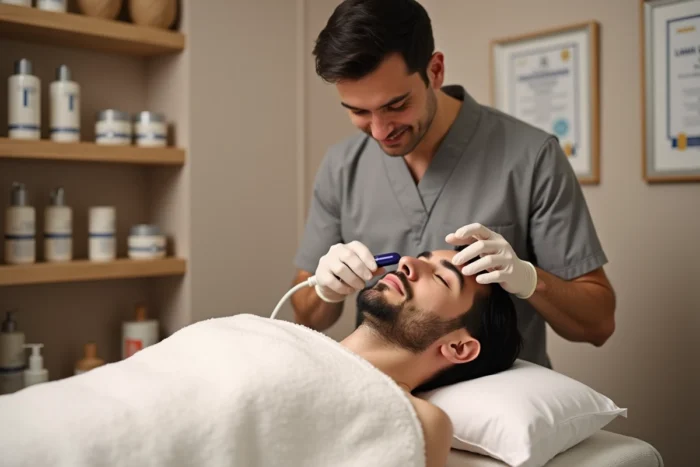
Aesthetic treatments and aesthetic medicine: a strict regulatory distinction
The French legal framework separates three categories of facial procedures. Confusing them amounts to allowing an untrained person to perform a procedure that is outside their competencies.
- Aesthetic treatments: skin cleansing, hair removal, application of cosmetic products, comfort massage. Reserved for holders of a CAP Esthétique or an equivalent recognized diploma, in accordance with Article L. 121-1 of the Crafts Code.
- Aesthetic medicine treatments: hyaluronic acid injections, botulinum toxin, medical laser, deep peels. Procedures reserved exclusively for physicians due to their invasive nature and associated vascular or neurological risks.
- Health treatments (medical or paramedical): lymphatic drainage, ultrasound electrotherapy. Reserved for physicians and medical assistants by the Public Health Code.
A beauty institute that offers injections or medical laser operates outside its legal framework. The DGCCRF has also reminded that some cosmetic products misused pose health risks, particularly those containing bleaching substances or highly concentrated active ingredients unsuitable for unsupervised use.
Personalized skin diagnosis: what a professional evaluates before any facial treatment
Applying a treatment without prior skin analysis is akin to treating blindly. A qualified professional, whether a licensed aesthetician or an aesthetic physician, begins with a skin diagnosis that conditions the entire protocol.
This diagnosis covers the phototype (skin reaction to the sun), the level of seborrhea, the presence of an altered skin barrier, any dermatological pathologies (rosacea, eczema, inflammatory acne), and the history of allergic reactions. A peel suitable for a light phototype can cause lasting hyperpigmentation on darker skin if the practitioner does not take this variable into account.
The aesthetician in the institute adjusts the concentration of active ingredients, the application time, and the frequency of treatments based on this assessment. The aesthetic physician, on the other hand, has complementary tools (dermatoscope, skin imaging) to evaluate the deeper layers of the skin before proposing an invasive procedure.
Professional cosmetic products and over-the-counter products
The ranges used in institutes or medical practices are not simply “premium” versions of mass-market products. Their formulation contains higher concentrations of active ingredients, making them effective but potentially irritating without a controlled application protocol.
A glycolic acid treatment dosed for professional use requires precise neutralization and a controlled application time down to the second. If mismanaged, it can cause chemical burns. Que Choisir lists numerous facial treatments containing ingredients to watch out for, which reinforces the importance of guidance from a professional capable of reading and interpreting compositions.

Long-term consistency of treatments: a global protocol rather than isolated gestures
A one-time treatment can temporarily enhance the glow or texture of the skin. However, facial aesthetics is built over time, with a strategy that considers skin evolution, seasons, and age.
A qualified practitioner establishes a progressive treatment protocol: they space out sessions, adjust active ingredients based on the skin’s response, and know when to refer to a physician if the request exceeds the aesthetic scope. This continuity avoids the common mistakes of “one-off treatments,” where contradictory procedures (an aggressive peel followed by an overly rich occlusive treatment, for example) degrade the skin barrier instead of reinforcing it.
Professional follow-up also allows for early detection of anomalies. A pigmented spot that evolves, a lesion that does not heal, a mole that changes shape: the trained practitioner identifies these signals and refers to a dermatologist before the situation complicates.
The face concentrates both the most visible and the most fragile areas of the body. The skin there is thin, vascularized, and constantly exposed. Choosing a qualified professional to take care of it means accepting that the technicality of the gesture is as important as the product applied.