
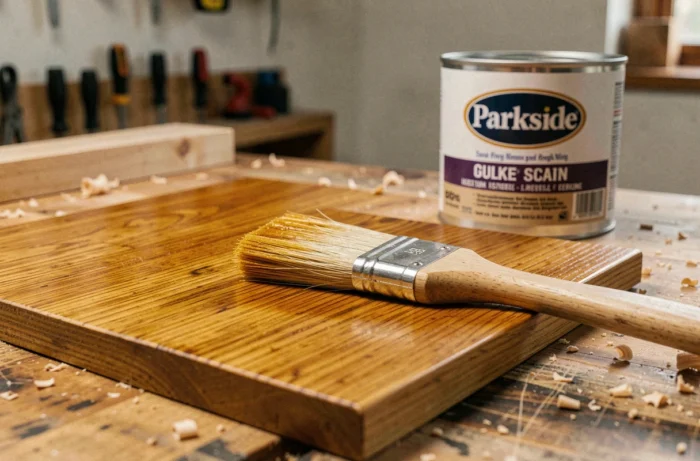
You have wooden cladding, shutters, or a garden shed that is starting to gray. You are looking for an effective wood stain without breaking the bank. The Parkside polyurethane stain often comes up in discussions among DIY enthusiasts, particularly because it is sold by Lidl at a very accessible price. The question remains whether this product truly lives up to its promises against the elements and UV rays.
Polyurethane resin in a wood stain: what it really changes
Most traditional stains use acrylic or alkyd resins. They form a flexible film that protects the wood on the surface. Polyurethane resin, on the other hand, creates a harder layer that is more resistant to abrasion.
For a stain intended for exterior wood, this hardness brings two direct advantages. The film better withstands friction (like opening and closing shutters, for example). It also absorbs thermal shocks more effectively, where a softer resin may eventually crack after several winters.
The downside is often a higher VOC content than in water-based stains. Solvent-based products, which many polyurethane stains are part of, show higher emissions of volatile organic compounds. The European directive 2004/42/EC sets distinct emission ceilings depending on whether the product is water-based or solvent-based, and the thresholds gradually tighten.
In practice, this means that application requires proper ventilation and the wearing of a suitable mask, even outdoors in calm weather. This is a point that Parkside product sheets rarely mention in detail.
A comprehensive file on the Parkside polyurethane stain for wood according to Bossa Studio Déco details the performance in real conditions and user feedback on the durability of the film after several seasons.
Parkside stain versus specialized brands: where the gap lies
Parkside is Lidl’s own brand for tools and DIY products. It has been around for about thirty years and covers a very wide catalog, from drills to wood finishing consumables.
You may have noticed that stains from brands like V33, Bondex, or Syntilor have significantly higher prices per liter? The gap is partly explained by the formulation. Specialized brands invest in more effective UV filters and micronized pigments that extend color retention.
Parkside offers a consistent quality-price ratio for less exposed surfaces. Cladding under a roof overhang, a garden gate, or an outdoor storage box does not face the same level of exposure as a south-facing facade.
Criteria to check before buying
- The number of coats recommended by the manufacturer. If the sheet indicates three coats where a competitor only requires two, the actual cost per square meter becomes comparable.
- The announced UV resistance. A stain without effective anti-UV filters will allow the wood to gray in one season, even with a hard polyurethane film.
- The type of compatible support. Some polyurethane stains do not adhere well to already treated or painted wood. Pre-sanding may be necessary.
- The drying time between coats. Solvent-based formulations sometimes dry more slowly in humid weather, complicating application over several days.
On DIY forums, feedback is mixed. Satisfied users describe easy application and a decent finish in the first year. Critiques mainly focus on durability beyond two seasons, with a film that can peel in areas highly exposed to the elements.
Climate conditions and stain choice: an underestimated factor
The market for exterior wood protection products is experiencing growth driven by home renovation and the increasing number of wood installations (decks, cladding, pergolas). Recent sector analyses highlight a growing demand for so-called “long-lasting” finishes, capable of withstanding increasingly contrasting weather conditions.
Polyurethane stains retain an advantage in regions subjected to frost, strong UV rays, and frequent rains. Their rigid film better withstands freeze-thaw cycles than a standard acrylic stain. It is precisely under these conditions that the difference with an entry-level product is most noticeable.
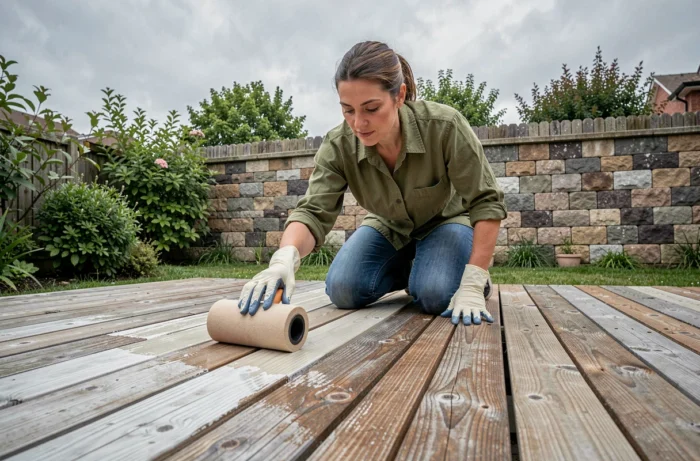
On the other hand, in a temperate climate with moderate exposure, a water-based stain offers comparable results while being easier to apply and clean. The choice is therefore not just a matter of brand, but of matching the product with the actual environment of the wood to be treated.
When Parkside stain is a good choice
For a partially sheltered garden shed, low fences, or outdoor furniture that you can easily re-treat each year, the affordable price of Parkside stain justifies its use. The polyurethane provides adequate mechanical resistance for these uses.
For shutters facing south or unprotected cladding, it is better to invest in a high-protection stain with enhanced UV filters. The price difference per liter, usually a few euros, is compensated by the frequency of renewal.
Preparing the wood before applying a polyurethane stain
Regardless of the chosen brand, the preparation of the surface determines the longevity of the treatment. Poorly prepared wood will undermine even the best stain on the market.
- Sand the wood with medium grit to open the fibers and ensure the adhesion of the polyurethane film.
- Thoroughly dust the entire surface. Sanding residues prevent the stain from penetrating properly.
- Treat areas affected by fungi with a suitable fungicide before any application of stain.
- Apply the first coat in a thin and even layer, then respect the indicated drying time before the second coat.
Well-sanded and dusted wood doubles the lifespan of the finish. This is the action that makes the real difference, much more than the choice between two brands of comparable range.
The Parkside polyurethane stain remains a relevant option for DIY enthusiasts who regularly treat their exterior wood and are willing to renew the application more often than with a high-end product. The budget saved at purchase is reinvested in work time, a trade-off that depends on each situation.