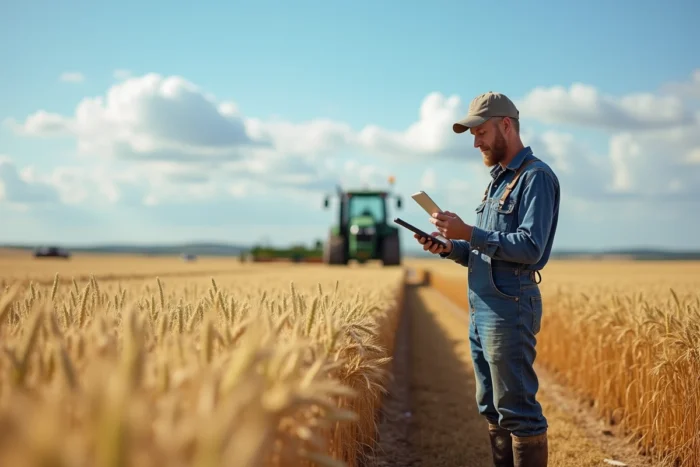
What measurable gains do recent technologies bring to a farm operation, and which tools truly justify an investment in 2026? Between regulations on phytosanitary drones, electronic invoicing, and IoT sensors, the levers for modernization are not all equal. This article compares their concrete effects on the daily management of a farm.
Phytosanitary Drones, IoT, and Management Software: A Comparison of Agricultural Innovations 2026
Not all innovations address the same needs. Some target field production, while others focus on administrative management. The table below summarizes three categories of technologies based on available regulatory and sector data.
| Innovation | Main Function | Regulatory Framework 2025-2026 | Type of Farm Concerned |
|---|---|---|---|
| Phytosanitary application drone | Targeted treatment on difficult plots | Law of April 23, 2025, decree No. 2026-422 of May 29, 2026 | Vines, banana plantations, steep plots |
| IoT sensors (soil, climate, animals) | Remote monitoring and data collection | No specific framework, CE standards on connected devices | Field crops, livestock, market gardening |
| Management software and electronic invoicing | Administrative management, tax compliance | Electronic invoicing reform 2026 | All farms |
This comparison shows that each tool targets a different link in the management chain. A vineyard owner in a hilly area and a cereal farmer in a plain do not have the same investment priorities.
Various technical solutions are referenced on specialized platforms, such as https://www.agrisystems.net/, which gathers equipment and software dedicated to agricultural operations.
Agricultural Drones in France: What Changes with the May 2026 Decree
The use of drones to apply phytopharmaceutical products remained prohibited in France until recently. The law of April 23, 2025, opened a first breach, and the decree No. 2026-422 of May 29, 2026 specifies the application modalities.
Eligible Plots and Authorized Products
The framework is strict. Only plots with a slope of 20% or more, banana plantations, and mother vine plots conducted on the ground are concerned. The order of May 19, 2026, approved a list of about 150 products applicable by drone, limited to biocontrol products, usable in organic farming and classified as low risk.
Trial Programs for Other Crops
The decree also provides for trial programs lasting up to three years on other types of plots. This provision paves the way for gradual extension, but no generalization schedule is set at this stage.
For an operator, the operational interest is twofold:
- Reduction of the physical exposure of applicators on rugged terrain, where the passage of a conventional sprayer poses safety issues
- Better control of spray drift thanks to low-altitude flights and calibrated nozzles, which limits product loss off-target
- Access to areas previously treated manually or left without intervention, with a significant time gain per pass
However, the cost of acquiring or hiring a drone remains a barrier for small structures. The economic interest directly depends on the sloped area and the frequency of treatments.
IoT Sensors and Agricultural Data: Remote Monitoring of Crops and Soil
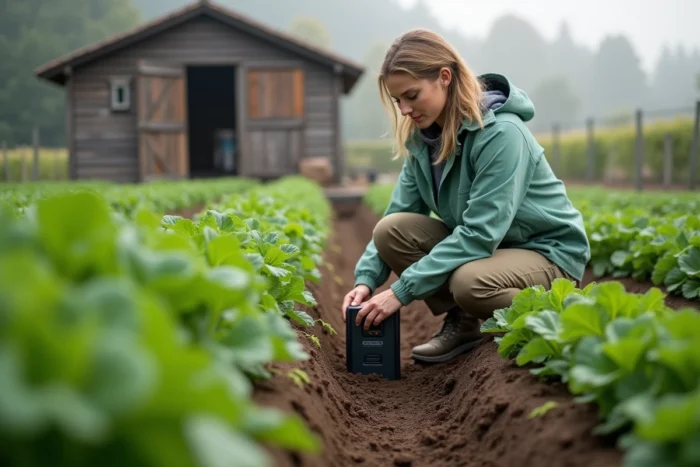
Connected sensors (soil moisture, temperature, humidity, animal activity) form the foundation of precision agriculture. Their value does not lie in the sensor itself, but in the ability to transform the collected data into management decisions.
A network of tensiometric probes coupled with a local weather station allows, for example, to adjust irrigation plot by plot. Without this type of data, the farmer irrigates according to a fixed schedule or a visual estimate, which generates either excess water (energy costs, nutrient leaching) or a deficit (water stress, yield loss).
The collection of data also raises questions about ownership and confidentiality. Farmers using third-party platforms to store and analyze their production data must check the terms of use. Agricultural data has increasing commercial value, and some software publishers reserve rights to aggregated exploitation in their contracts.
Agricultural Electronic Invoicing: The 2026 Reform as a Management Lever
The reform of electronic invoicing, which is accelerating its deployment in 2026, directly affects farm operations. Isagri, a specialized publisher, positions this reform as a lever for the overall modernization of administrative management in farms.
The transition to electronic invoicing is not just a change in format. It requires structuring accounting flows, connecting the management software to a partner dematerialization platform, and adapting internal processes (validation, archiving, bank reconciliation).
For farms that were still operating with paper invoices or spreadsheets, this obligation accelerates the adoption of integrated management software. The gain is measured in the long term: fewer input errors, enhanced traceability, simplified accounting preparation.
Conversely, for structures already equipped with agricultural ERP, compliance mainly represents a technical update. The workload gap between these two profiles is considerable, and this is where the real hidden cost of the reform lies: not the software, but the reorganization of practices.
Adoption of Agricultural Digital Tools: Barriers Persist Despite Available Tools
A survey conducted by Phyteis among 280 farmers assesses the perceived usefulness of digital tools for crop protection. The results show that the digital transition is underway but remains uneven across sectors. The criteria that favor adoption are ease of use, reliability of generated recommendations, and perceived cost-benefit ratio.
Another study on the perception of digital agronomy confirms this trend: farmers who already use a digital tool more easily adopt a second one. The first step remains the most difficult, and it often depends on the support offered by cooperatives or agricultural chambers.
The main trap would be to multiply subscriptions to non-interoperable platforms. An IoT sensor that does not communicate with the plot management software creates an additional data silo, not a gain in efficiency.
The farms that make the best use of these innovations are those that choose their tools based on an identified operational need, not a technological promise. The most useful data remains that which triggers a concrete action on the ground.