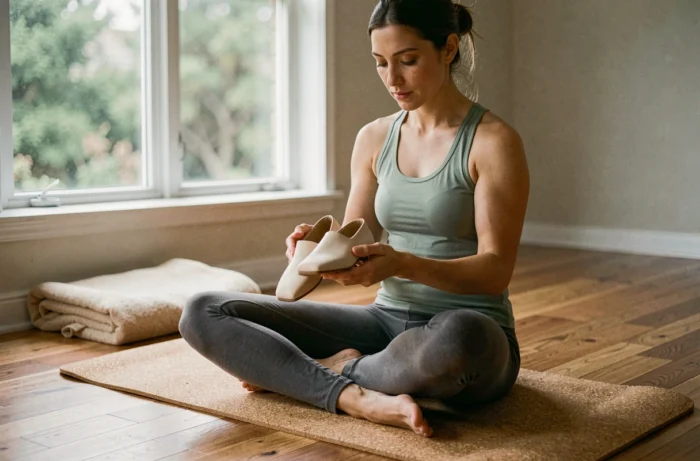
Yoga is primarily practiced barefoot. Direct contact with the ground enhances proprioception and stability in balance postures. Therefore, choosing shoes for a yoga session is not about finding a high-performance model like for running or trail, but about identifying situations where a minimum level of protection becomes necessary, without sacrificing foot sensation.
Barefoot or yoga shoes: when the question really arises
In a studio, on a standard mat, practicing barefoot remains the standard. The bare foot captures micro-variations in the ground, which helps adjust support in real-time during a Warrior III or a Tree Pose.
The question of footwear becomes relevant in specific contexts. Outdoor yoga exposes the feet to cold, stones, and uneven surfaces. Individuals suffering from acute plantar fasciitis or advanced osteoarthritis need a protective layer to avoid worsening pain. Podiatrists advise against practicing barefoot for diabetic individuals due to the risk of unnoticed injuries.
In these cases, an appropriate shoe allows continued practice without compromising foot safety. The selection criteria differ radically from those applied to running or fitness shoes, and this is where most mistakes occur. To delve deeper into this topic, Sportivoz’s dedicated page details the models best suited for each type of practice.
Thin sole and flexibility: the technical criteria for a suitable yoga shoe
A yoga shoe has almost nothing in common with a classic sports shoe. The goal is to replicate the sensation of being barefoot as much as possible while adding minimal protection.
Sole thickness
The sole must be ultra-thin to maintain ground sensory feedback. A thick, cushioned sole, like that of a running shoe, cuts off proprioception. The foot no longer perceives surface variations, and balance deteriorates, which is the exact opposite of what yoga aims to develop.
Overall flexibility
The shoe should be able to bend in all directions without resistance. If it does not easily twist in hand, it will limit toe movement in floor postures. Soft and lightweight materials are a priority.
Toe box width
The toes must be able to spread naturally. A wide toe box is a non-negotiable criterion. City or running shoes often compress the front of the foot, preventing the activation of stabilizing muscles during standing postures.
Sole grip
Grip is just as important as on a mat. An anti-slip pattern on the outsole prevents slipping, especially outdoors on wet grass or hard surfaces. Without reliable grip, the shoe becomes a factor of imbalance.
The criteria to check before purchase can be summarized as follows:
- Thin sole (a few millimeters), flexible and flat, with no heel-to-toe drop
- Breathable material to limit sweating during long sessions
- Toe box wide enough to allow natural toe splay
- Negligible weight, so as not to alter the lightness sensation inherent to yoga
- Outsole with an anti-slip pattern suitable for smooth and outdoor surfaces
Minimalist shoes for yoga: transition and precautions
Shoes described as “barefoot” or minimalist meet most of the listed criteria. They are designed to replicate the biomechanics of the bare foot while providing protection from ground aggressions. Several brands offer models oriented towards yoga, pilates, and dance, with soles divided into several segments to increase flexibility.
A point often overlooked: transitioning from a classic shoe to a minimalist shoe does not happen overnight. Podiatrists recommend a gradual transition of at least four to eight weeks. During this period, the foot must adapt to the lack of cushioning and arch support. Starting by wearing minimalist shoes for a few minutes a day and then gradually increasing the duration limits the risk of calf or Achilles tendon pain.
A study on the regular use of minimalist shoes in healthy adults showed that this type of footwear does not lead to significant changes in foot imprint or degradation of postural stability, with only two minor and transient adverse events reported. The safety argument is therefore strong for individuals without pre-existing conditions.
Dynamic yoga or gentle yoga: the style of practice influences the choice
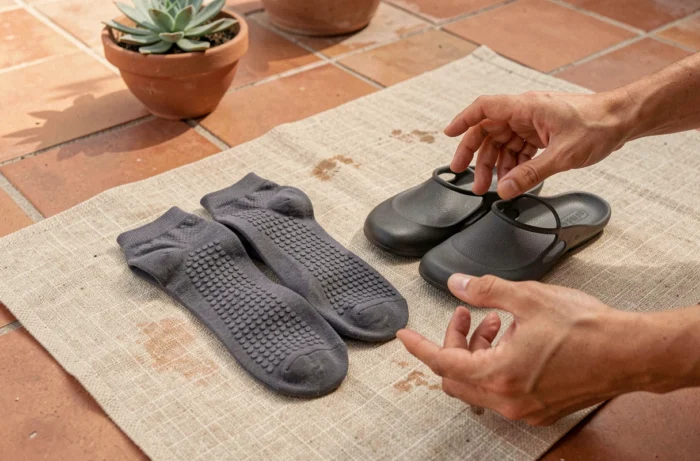
The type of yoga practiced directly influences the level of support needed. A Yin yoga class, slow and on the ground, requires little grip and lateral support. An anti-slip sock may suffice in this context.
For Vinyasa or Ashtanga, the fast sequences and transitions from standing to the ground require more grip and stability. A minimalist shoe with an anti-slip sole becomes more relevant than a simple sock. Even light lateral support helps stabilize the foot in dynamic asymmetrical postures.
The choice also depends on the environment:
- In a heated room, sweating increases, and breathable material prevents slipping inside the shoe
- Outdoors on grass or dirt, sole protection takes precedence over sensory finesse
- On hard surfaces (concrete, tiles), a minimum of cushioning may be considered for sensitive joints, as long as the sole remains thin
The choice of shoes for yoga is less about the brand or price and more about the suitability between the model, foot morphology, and practice context. A shoe that compresses the toes or prevents feeling the ground negates the proprioceptive benefits that yoga builds posture by posture. The best option remains the one that makes you forget you are wearing something on your feet.