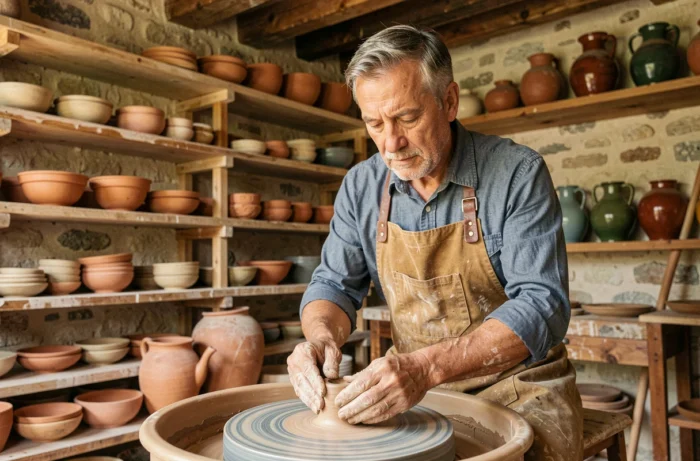
French craftsmanship encompasses all activities of manufacturing, transforming, repairing, or providing services primarily done by hand or with the help of manual tools. Since 2023, artisan registration must go through the National Register of Enterprises (RNE) via the INPI’s single window, including for micro-entrepreneurs. This legal framework structures a sector where each handmade object relies on a precise technical gesture, passed down through learning.
Quality of artisan in France: a title protected by law
The term “artisan” is not just a commercial qualifier. Its use is regulated by the craft code, the current regulatory part of which stems from decree n° 2023-500 of June 22, 2023. The abusive use of the title artisan can be punished with a fine of up to 7,500 euros.
To claim this quality, two cumulative conditions must be met: being registered with the RNE in the artisan category and justifying a diploma (CAP, BEP, equivalent title) or professional experience of at least three years in the relevant trade. Without this qualification, a professional can engage in manual work but does not have the right to present themselves as an artisan.
This distinction protects the consumer. When a ceramist, cabinetmaker, or leatherworker displays the title of artisan, it guarantees a verified level of skill. Platforms like L’Atelier Singulier allow you to discover creators whose know-how is based on this qualification requirement.
Raw materials and technical gesture: what distinguishes a handcrafted object
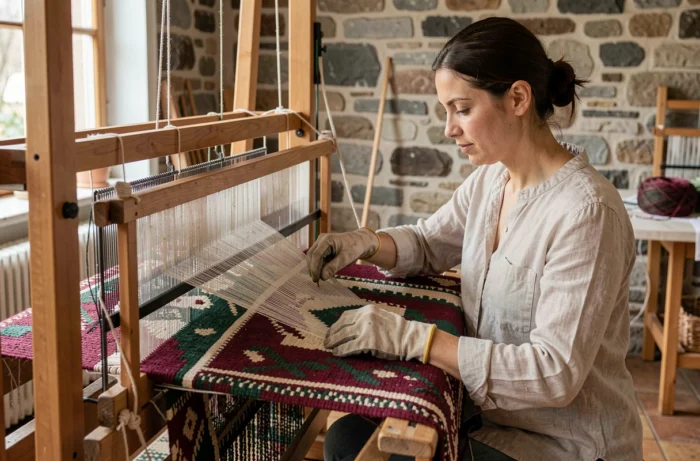
A handmade object is not defined solely by the absence of industrial machinery. The difference lies in the relationship between the raw material and human decision at each stage of production.
A woodturner selects a log based on its grain, knots, and moisture content. They adjust the lathe speed, the angle of the chisel, and the depth of cut. Two pieces from the same trunk will never be identical. This controlled variability is the hallmark of artisanal manufacturing.
Wood, leather, clay: constraints specific to each material
The choice of material determines the technique and production time. A potter works the clay according to its chamotte content and plasticity. A saddler prepares the leather to the desired thickness before stitching it with saddle stitch, a gesture that requires two needles and a single waxed thread.
- The work of wood requires controlled drying (natural or in a drying chamber) before any shaping, to avoid later deformation of the piece
- Vegetable-tanned leather, prized in artisanal leather goods, requires several weeks of treatment in bark baths, compared to a few hours for industrial chrome tanning
- Earthenware and stoneware require at least two successive firings, each altering the structure and color of the piece in a partially unpredictable manner
These constraints explain why the price of a handcrafted object reflects an unavoidable working time. Mass production eliminates these variations; the artisan, on the contrary, works with them.
Artisanal workshop and transmission of know-how
The workshop remains the central place of artisanal creation. It is here that the transmission occurs between a master artisan and an apprentice, through imitation of the gesture followed by gradual correction. Apprenticeship remains the most structured learning path for manual trades in France.
An apprentice carpenter, for example, learns to draw a template (full-scale technical drawing) before touching a cutting tool. This step through drawing requires understanding the geometry of the assembly before execution. The gesture comes after understanding.
Apprenticeship as an economic pillar of craftsmanship
The chambers of trades and craftsmanship (CMA) support this transmission. The 2025 panorama of the CMA Centre-Val de Loire shows an active renewal of artisanal businesses in the region, driven notably by apprenticeship. Occitanie confirms this trend with a notable increase in the number of artisanal businesses in recent years.
This dynamism is partly explained by the appeal of professional retraining towards manual trades. Profiles from the tertiary sector choose ceramics, woodworking, or sewing, attracted by the concrete nature of the work and the possibility of producing unique creations.
Identifying a true handcrafted product: concrete criteria
In the face of the proliferation of “handmade” or “artisanal” mentions online, a few checks can help distinguish an authentic creation from an industrial product dressed in marketing.
- Check that the seller displays a SIREN number and registration with the RNE in the artisan category, which can be verified on the INPI website
- Observe the variations between two pieces from the same series: slight differences in hue, texture, or dimension, indicating manual production
- Inquire about the origin of the raw materials and the place of manufacture, two pieces of information that a transparent artisan communicates easily
- Favor creators who explain their manufacturing process (steps, tools, duration), as technical transparency is a reliable indicator
Labels such as “Living Heritage Company” (EPV) or the mention “Master Artisan” provide additional guarantees. Their attribution is based on verifiable criteria: excellence of know-how, longevity of activity, training capacity.
French craftsmanship is not just about aesthetics or a sales argument. Behind every handmade object, there is a strict regulatory framework, materials whose behavior dictates the technique, and a learning time that nothing can shorten. It is this combination that gives an artisanal piece its lasting value.